
The clipboard, the whiteboard, the dog-eared notebook full of set-piece diagrams. For decades, these were the tools of the trade for football coaches at every level. Not anymore. AI coaching tools in football have moved from experimental novelty to genuine competitive infrastructure, and the pace of adoption across English football in particular has been remarkable. From Premier League giants with nine-figure budgets to Championship clubs trying to punch above their weight, the technology is reshaping how teams train, analyse opponents and develop individual players.
This isn’t just a story about the elite. The cost curve for these platforms has dropped sharply, and mid-table Championship sides, League One clubs and even some well-resourced non-league teams are starting to get access to tools that would have been unimaginable five years ago.
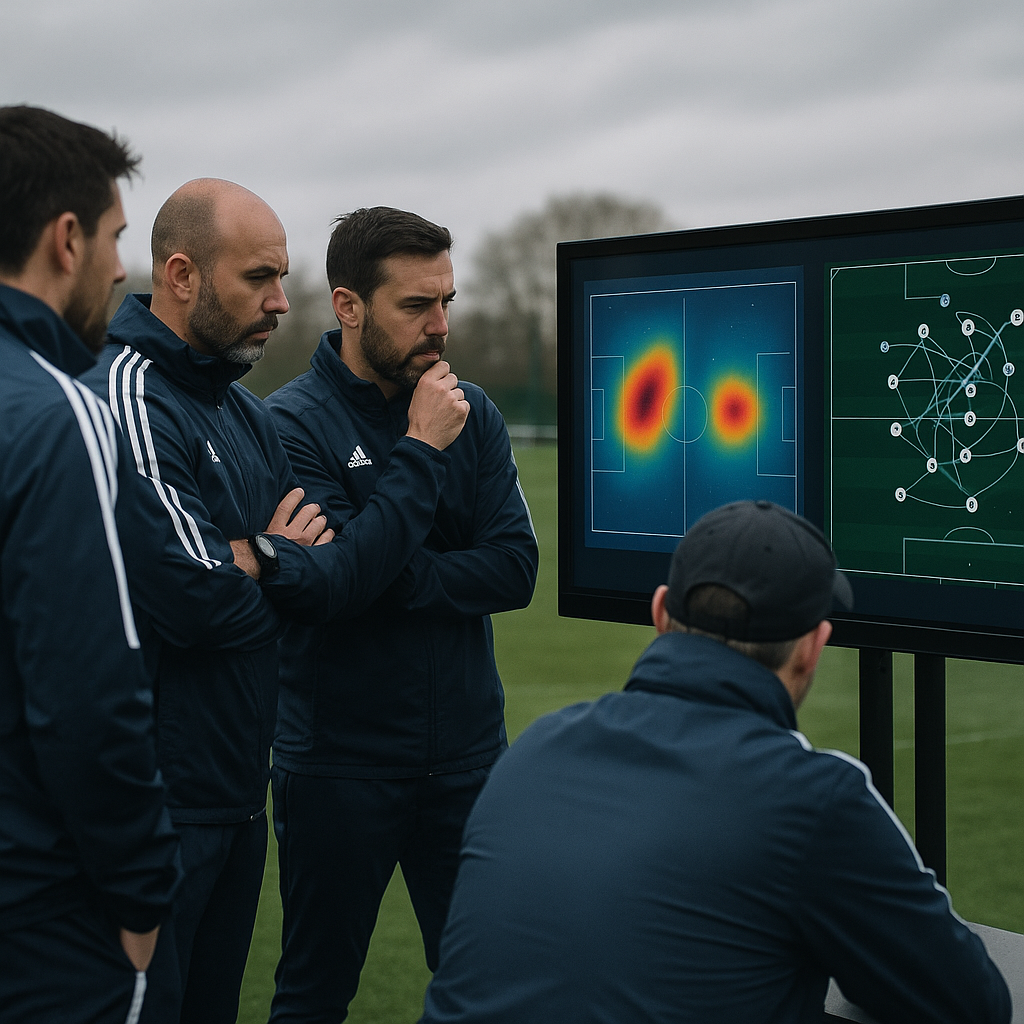
What AI Coaching Tools Actually Do at Club Level
The term gets thrown around loosely, so it’s worth being precise. Modern AI coaching tools in football tend to operate across three main areas: automated video analysis, tactical pattern recognition, and personalised player development planning.
Automated video analysis is probably the most mature application. Platforms like Stats Perform, Hudl Sportscode and SciSports can ingest hours of match footage and automatically tag events: pressures, progressive passes, defensive shape transitions, off-ball runs. What used to take an analyst four or five hours to tag manually now happens in minutes. The system flags patterns, highlights key sequences and even generates ready-to-present clips for the coaching staff. At Arsenal and Manchester City, entire analyst departments now use AI-assisted review as a base layer, then apply human judgement on top.
Tactical pattern recognition goes a step further. These tools don’t just tag events; they look for repeating structural patterns in how an opponent sets up. Pressing triggers, weak-side overloads, defensive compactness metrics. Clubs like Brentford, who built much of their recent success on data-driven recruitment and analysis, have leaned heavily into this kind of work. Their analytical approach, long before it became fashionable, was a preview of where the whole industry was headed.
Personalised Player Development Plans: The Real Game Changer
The area generating the most excitement right now is personalised development planning at the individual player level. This is where AI coaching tools in football stop being about the team and start being about the person.
Platforms such as Catapult, Playermaker and Metrica Sports combine GPS load data, video tracking and performance benchmarks to generate bespoke development profiles. A midfielder’s pass completion under pressure, a defender’s recovery speed over repeated sprints across a training block, a winger’s decision-making in wide 1v1 situations. The system builds a picture over weeks and months, identifies gaps against positional benchmarks, and suggests targeted drill work.

At academy level this is particularly powerful. The Football Association has been exploring how AI-assisted development tools can improve the identification and nurturing of young talent, particularly in areas where traditional scouting networks are thin. According to BBC Sport, several Category One academies have already integrated AI video review into their Under-18 programmes, with coaches reporting that it frees up significant time to focus on actual coaching rather than administrative analysis.
Can a Machine Really Replace Football Intuition?
Here’s the honest answer: no, not entirely. And most people building these platforms will tell you the same. The best AI coaching tools in football are designed to augment the coach, not replace them. The machine is extraordinarily good at processing volume. It never gets tired, it doesn’t miss the same defensive error for the third consecutive match, and it can cross-reference a player’s current load data against historical injury risk profiles in seconds.
What it can’t do is read the room. It can’t sense when a dressing room is fractured, can’t judge whether a particular player needs an arm around the shoulder or a tough conversation. It doesn’t understand the cultural and psychological dimensions of team dynamics that shape performance as much as any tactical system.
The managers who are getting the most from this technology are the ones who treat it like a very fast, very thorough assistant. Pep Guardiola’s backroom staff at Manchester City are often cited as a benchmark here. The data informs decisions; the humans make them. That balance is critical.
Adoption Across the Football Pyramid
One of the most interesting shifts in 2026 is how AI coaching tools in football are filtering down through the English football pyramid. Premier League clubs have had sophisticated analytics departments for years. But the Championship and League One are catching up fast.
Middlesbrough, Coventry City and Preston North End have all invested in enhanced video analysis infrastructure in recent seasons. Several League Two clubs are using Hudl’s more accessible tier products to do post-match breakdown that rivals what a mid-table Premier League side was doing a decade ago. The democratisation of this technology is genuine, even if the gap between the very top and the lower leagues is still enormous in terms of resource and sophistication.
Grassroots football is still largely untouched by the serious AI platforms, though there are early signs of change. Apps like Veo and Trace allow amateur clubs to record matches automatically and generate basic statistical summaries. They’re nowhere near the capability of enterprise-level platforms, but they’re bringing data culture into Sunday league football for the first time.
The Tactical Arms Race Is Accelerating
There’s a broader competitive dynamic worth naming. When one club gains an analytical edge, rivals feel pressure to match it. That arms race is now running at speed across European football. English clubs are competing not just against each other but against technically sophisticated operations in Germany, Spain and Portugal.
The clubs that invest early in building internal data literacy, not just buying the software but training their coaching staff to actually use it, are likely to sustain the advantage longest. Buying a platform and not embedding it in daily practice is one of the most common and costly mistakes clubs make. The tool is only as good as the culture around it.
The clipboard isn’t dead. But it’s definitely been demoted. AI coaching tools in football are no longer a future-facing experiment; they’re a present-tense competitive necessity, and the clubs that understand that earliest will be shaping the next decade of the game.
Frequently Asked Questions
What are AI coaching tools in football and how do they work?
AI coaching tools in football use machine learning and computer vision to automatically analyse match footage, track player movements, identify tactical patterns and generate performance reports. They process data far faster than a human analyst could, flagging key events and trends for coaching staff to act on.
Which football clubs in England are using AI coaching technology?
Most Premier League clubs now use some form of AI-assisted analysis, with Manchester City, Arsenal and Brentford frequently cited as leaders in data-driven coaching. Championship clubs like Middlesbrough and Coventry City have also invested in enhanced analytics infrastructure in recent years.
Can AI replace a football coach entirely?
No. AI tools are designed to assist coaches, not replace them. The technology excels at processing large volumes of data and spotting patterns, but it cannot manage player psychology, dressing room dynamics or the nuanced human judgement that effective coaching requires.
Are AI coaching tools available for grassroots or amateur football clubs?
Entry-level tools like Veo and Trace are being used by amateur clubs to automatically film matches and generate basic stats. They are far less sophisticated than enterprise platforms, but they represent a genuine first step in bringing data culture to grassroots football.
How much do AI football coaching platforms cost?
Costs vary enormously by platform and tier. Enterprise solutions used by Premier League clubs can run into six figures annually when combined with dedicated analyst staff. More accessible products aimed at lower-league or academy sides can start from a few hundred pounds per season, making them increasingly viable for clubs outside the top divisions.